
Or, what makes Recoolit’s credits best-in-class?
Refrigerant destruction carbon credits come in two major flavors: recovery and stockpile. Buyers should understand the differences and be clear on what they’re buying.
The typical “ODS project” is sourced from large stockpiles of gas where the baseline is slow leakage over a 10-year period. Recoolit’s carbon credits, on the other hand, come from supporting HVACR technicians in day-to-day operations, helping prevent gas from being emitted today when cooling devices reach end-of-life.
In this post we break down the different factors for refrigerant carbon credits. But first, here’s a quick cheatsheet to use when deciding what to buy.
Buyer cheatsheet: what to ask about your refrigerant credits
| Question | What to look for |
|---|---|
| What’s the source of the gas? Did it come from equipment or a stockpile? | Sellers should be able to break down what percent is from each type of source, and explain the exact circumstances of the equipment recoveries or the stockpile. |
| What is the project developer’s business model? Are carbon credits a catalytic source of emissions reduction, or a way to improve profitability of an existing business line? | If credits are subsidizing an existing business line, buyers should make sure they understand the full economic picture and be confident in the project’s financial additionality. |
| Was the release imminent or was it modeled over future years? | If the baseline is based on an assumed model of future release, sellers should be able to clearly explain and defend all assumptions used in the modelling (for example, the projected leak rate). |
| If this is from equipment recovery, was the recovery already required or economically attractive? | Credits are more additional when recovery is not otherwise incentivized. |
| When is the reduction credited relative to baseline emission? | Stockpile refrigerant credits are typically issued before the baseline emissions would have happened. Some buyers may prefer credits based on issuance-after-reduction. |
| What prevents manufacture-for-destruction? | Sellers should have a clear explanation of how they know the gas was not produced specifically to be destroyed. This may involve analysis of the economic incentives, production or import restrictions in countries, chain of custody evidence, or otherwise. |
| What evidence can the buyer inspect? | At minimum, lab testing and destruction evidence, along with high-level chain of custody. Some sellers offer detailed granularity and digital evidence packages showing refrigerant sourcing. |
| What lasting capacity does the project create? | Sustainable refrigerant management can reduce emissions for decades in emerging markets. Depending on where the gas is sourced, lasting capacity for emissions reductions may include technician training, infrastructure building, support of existing programs (grassroots, NGO-driven or governmental), and provision of recovery equipment in-country. |
Some of this may be a bit cryptic for now, so read on to understand the key differences between these projects and how they can fit into buyer portfolios.
The carbon market is diverse and complicated
There are many different types of carbon credits and it can be hard for buyers to parse the most relevant differences to find the credits that best meet their quality criteria. While ratings agencies and certifications have a role to play, buyers and intermediaries should also be doing their own diligence about the differences between different methodologies and different projects within the same methodology. Even sophisticated and experienced carbon market participants struggle to keep up to date with all the nuances. Within a particular niche, there are still massive differences between projects that are worth knowing.
The last year and half has seen a major wave of interest in superpollutant carbon credits, catalyzed by Google’s offtake[link] of refrigerant destruction credits from Recoolit and landfill gas credits from Cool Effect, and punctuated recently by the Beyond Alliance’s $100M commitment[link] to superpollutant mitigation. But superpollutants are a very broad tent, united mainly by the high climate impact (and short atmospheric lifetime) of the relevant gases.
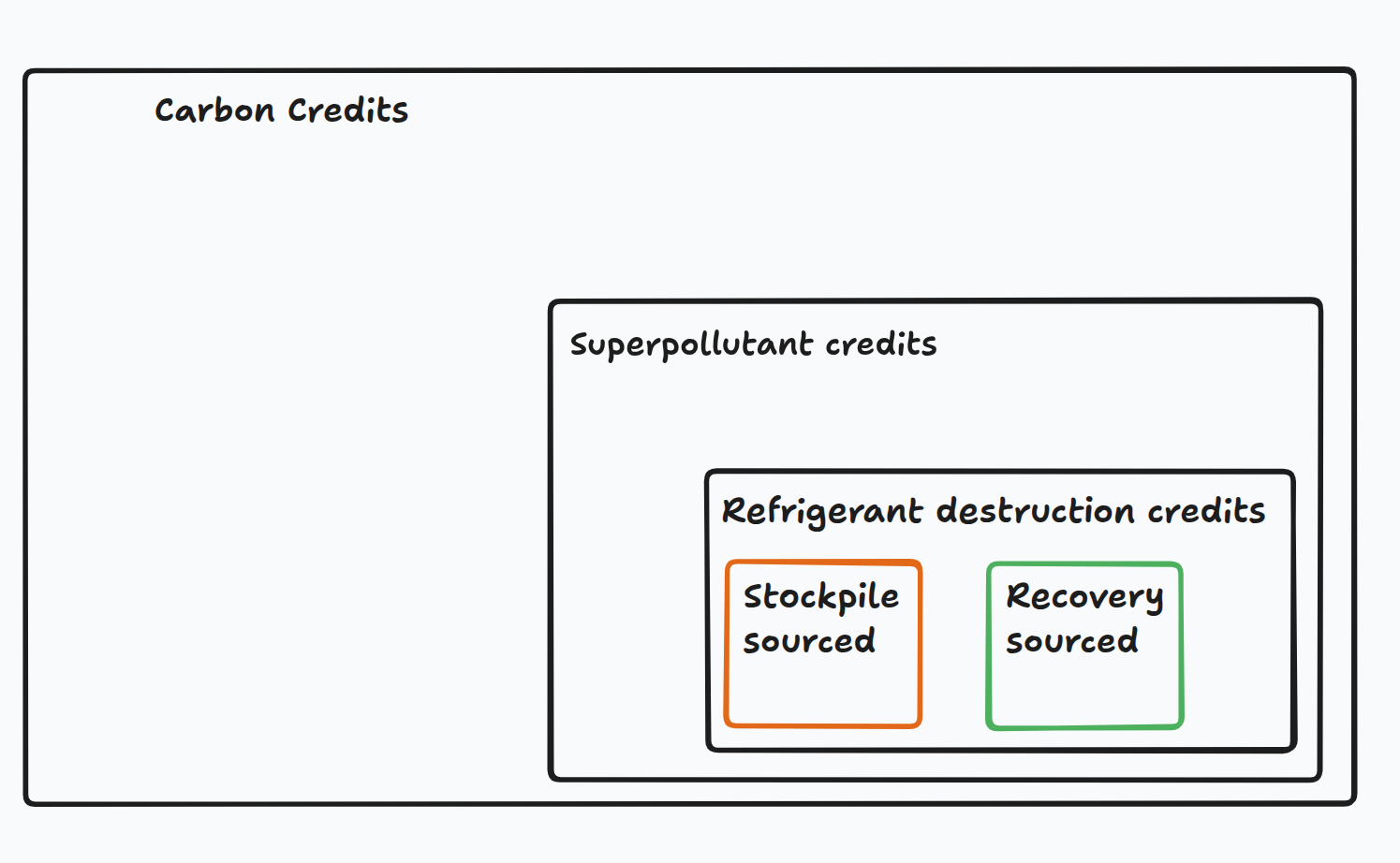
As project developers, we often need to explain how we fit into this broader category, and particularly how our project in Indonesia is different from other refrigerant destruction credits, like the stockpile-based ODS projects that many buyers have become familiar with over the last fifteen years. In particular, buyers want to know why our credits are more expensive than other refrigerant destruction credits they can find. Looking at the details of these projects explains both why our costs are higher and why that extra cost comes with additional benefits in credit quality.
The terminology is confusing.
You may have heard of “ODS destruction” or “refrigerant destruction” as a project type. The terminology gets a bit opaque, so let’s be (excessively?) precise.
-
Refrigerants are used in vapor-compression based cooling systems, typically for comfort cooling (air conditioning) or refrigeration.
-
ODS stands for Ozone Depleting Substances, such as CFCs and HCFCs, with production phased out starting in the late 1980s under the Montreal Protocol.
-
Not all ODS are CFCs or HCFCs.
-
Most ODS that are destroyed for carbon credits were intended to serve as refrigerants, although some were used as propellants and there are a few other uses.
-
-
HFCs were invented as replacements for ODS, for uses including as refrigerants. They are not ozone-depleting but still have very high global warming potential (GWP).
-
Most refrigerants in use today are HFCs, although there are still some ODS-based legacy systems, and newer systems may use lower-GWP alternatives such as HFOs or natural refrigerants.
Even though Recoolit destroys mostly HFCs, and most historical refrigerant projects are “ODS projects”, the type of gas is not the most important difference. The key difference is actually how the gas was sourced, and what would have happened to it in the baseline scenario. Recoolit also destroys some ODS, and the legacy projects might also destroy some HFCs. So in this post we distinguish between legacy “stockpile projects” and Recoolit’s innovative “recovery projects”, instead of using the potentially-misleading HFC vs ODS terminology.
A Recoolit Credit
A Recoolit credit starts with an AC technician somewhere in Indonesia, usually a low-wage worker with limited formal training. They might be freelance, or work full-time for either a contractor or in-house on a commercial facility. We enroll these technicians in the Recoolit program, educate them about the environmental impact of refrigerants, provide them training in how to perform refrigerant recovery safely, and help them install our app on their phone.
Weeks or months later, in the course of their day-to-day work, they get called to perform maintenance or decommission an end-of-life unit. Before, this would lead them to vent out all the refrigerant in the system: they don’t have the tools for recovery, or any option for disposing of the gas sustainability. But they remember their training, and contact Recoolit. We send recovery equipment on-demand to the job site, and sometimes provide hands-on field support for large or tricky recoveries, ensuring that the gas ends up in a certified cylinder, not the atmosphere. If we didn’t recover the gas, it would be vented on the spot, immediately hitting the atmosphere and warming the planet.
The technician gathers full documentary evidence including a photo of the AC unit nameplate, and we pay them an incentive for each kilogram collected. The amount of incentive we pay is capped well below the market price of virgin refrigerant, as assessed by regular price surveys, to ensure there’s no perverse incentive. Then we ship the full recovery cylinders back to one of our facilities, test it at an independent lab, and destroy it at a partner facility in Indonesia. Carbon finance allows Recoolit to pay for all of this: we buy the recovery equipment, pay for it to be shipped to the job site, pay the technician incentive, rent and staff warehouse space, and pay for lab testing and destruction, all within Indonesia, helping build recovery infrastructure that will drive emissions reductions for decades to come.
A few months later, the credits are issued with a vintage year based on the year of destruction, well after the actual emissions reductions have happened. Finally, we can deliver the credits to the buyers who support this work. The buyers receive a login to our software platform, allowing them to see the full chain of custody and all data associated with their emissions reduction, with gram-level granularity.
A Stockpile Credit
A typical stockpile credit might start with a chlorofluorocarbon (CFC) produced decades ago. CFCs have been phased out around the world since the ratification of the Montreal Protocol starting in 1989, but some of them are still sitting around in garages and warehouses around the world. A project developer finds a stockpile of CFCs which can no longer be sold to market. It might be in the US or elsewhere, and either privately owned or belonging to a government body. They acquire the gas, then ship it to a destruction facility: typically moving it from a developing country without its own destruction facility, to one in a developed country.
The emissions reduction in this case is based on an assumed leak rate, credited over a ten year period: if the assumption is a 25% yearly leak rate, then ~95% would have leaked out over ten years and the project gets issued credits equivalent to 95% of the gas destroyed. This leak rate is assumed, not based on the actual historical leak rate of these specific cylinders. Given that the cylinders may already have been sitting around in the stockpile for 10-20 years, it’s not always plausible that such a high proportion of gas would leak out over the next ten. All the credits are issued up front with vintage year equal to year of destruction, although the actual emissions reductions are occurring over the following ten years.
Finally, buyers of these credits get a certificate with a serial number, indicating the purchased quantity.
Side by Side
At this point it should be clear that a recovery project will have higher costs than a stockpile project, or any destruction project that is cross-subsidized by other refrigerant-related revenue such as servicing or reclaiming gas. And it should also be clear why some buyers are willing to pay that premium. Here’s a simple breakdown of the main differences that buyers look at:
| Recoolit HFC Project | Typical Stockpile Project | |
|---|---|---|
| Source Type | Recovery (end-of-life or maintenance) | Stockpiles |
| Source Country | Article 5 Countries where cooling demand is growing and HFC phasedown is slowest. (At present, Indonesia). | Can be Article 5 or non-Article 5 country (eg USA). |
| Type of Gas | Mostly HFCs, some ODS | Mostly ODS. |
| Where destroyed | In the country where it’s collected (at present, Indonesia). | Typically but not always shipped to a developed country. |
| Green jobs in-country | Yes: thousands of HVACR technicians upskilled to adopt sustainable practices. | Limited, if any. |
| Incentive cap based on market price? | Yes: needed to ensure no perverse incentives. | Not generally required, not applicable in most situations. |
| Baseline | Immediate venting, based on country-level practices showing ubiquitous venting. | Slow leak over ten years, based on an assumed leak rate. |
| Crediting timing vs emissions | Crediting happens after emissions have been reduced. | Crediting happens up to 10 years before the emissions would have happened. |
| Buyer-facing evidence | Purchase-level data shown directly to buyers with gram-level granularity tracing gas from the AC unit through to destruction. | Project-level data available through the registry. |
| Project legacy | Thousands of trained technicians, equipment deployed broadly in-country, support spin-up of testing and destruction facilities in-country, support NOU with chain of custody tracking software. | Surgical in-and-out, limited long-term effects on refrigerant emissions in the project country. |
Can’t I just pick a methodology instead of looking at each project?
Buyers should be aware of the main differences between methodologies, but they should also investigat individual projects before making their purchases.
There are six major refrigerant destruction methodologies1, and they are similar in some key ways. They are: [list the 6 with links].
Here’s what they have in common:
-
In the baseline scenario, some or all of the refrigerant would have been released to the atmosphere;
-
Procedures for sampling the refrigerant and testing it in a laboratory, to assess its composition and therefore the relevant GWP;
-
Technology and process for destruction: weigh the destruction cylinder before and after the feeder on a calibrated scale so you know how much is destroyed, use TEAP-approved destruction technology with appropriate permits and with limited harmful emissions.
But they also differ in many key ways: which gases are eligible, which geographies are eligible, which IPCC Annual Report do they use to determine the GWP of the gas, are pre-existing stockpiles eligible,
MRV data requirements, baseline assessment, and timing of crediting vs emission reductions.
And the stockpile-vs-recovery difference we’ve laid out above doesn’t line up perfectly with methodologies, nor with projects. A single project might contain both approaches! And some projects may go above and beyond methodology requirements. For example, Recoolit’s current Indonesia project uses the Isometric HFC/ODS Methodology[link]. But we also provide, beyond the requirements, a full digital chain of custody and audit granularity shown to buyers [link to past post or sample image]. And we go out of our way to develop sustained capacity, including training and green jobs in-country This is why it’s important for buyers to understand the project-level details, not just the methodologies.
Conclusion
As you might expect from Betteridge’s Law, the answer is no: refrigerant destruction credits can be vastly different from each other in overall project approach, cost, carbon integrity, and lasting impact. To learn more about these differences or about Recoolit’s best-in-class credit integrity, reach out to our sales team [email link].
-
Note that not all refrigerant credits are from destruction! The Carbon Containment Lab has put together an explainer (now a bit outdated) on the different approaches[link]. ↩︎